+86 311 8533 5186
For professional hand tools, durability depends on more than the type of steel used. Two tools manufactured from the same steel grade can perform very differently if their heat-treatment processes are not properly controlled.
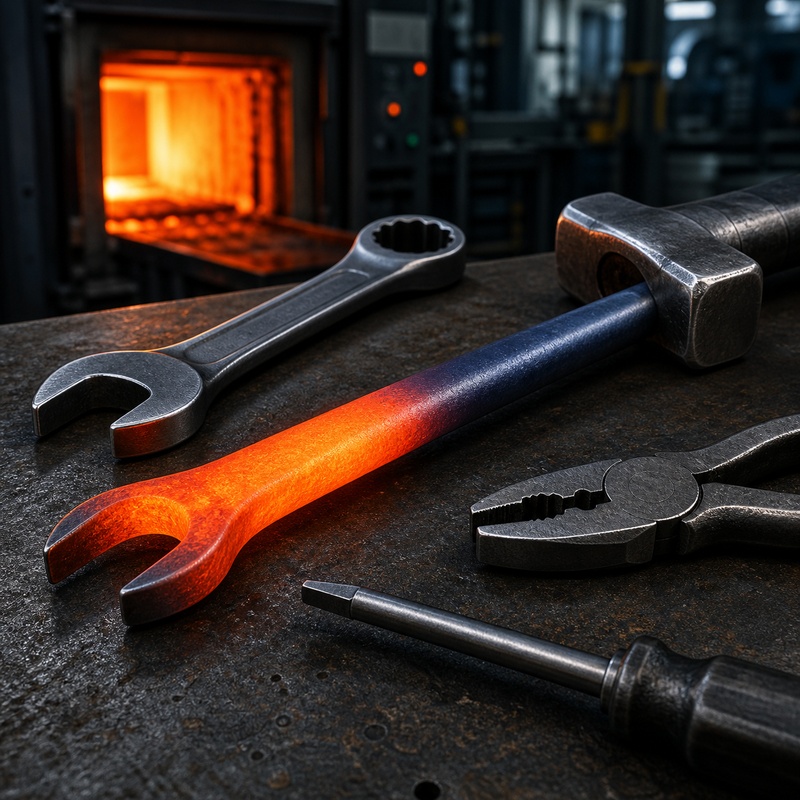
Heat treatment changes the internal structure of steel through carefully managed heating and cooling. When performed correctly, it gives a hand tool the hardness required to resist wear while preserving enough toughness to withstand impact and repeated loading. For distributors and private-label brands, understanding this process can make supplier evaluation and product selection more reliable.
Hand tools are exposed to several types of stress during use. Pliersexperience repeated gripping pressure, wrenches carry high torque loads, hammersabsorb impact, and cutting tools must maintain sharp edges.
Hardness to resist indentation, deformation, and wear
Toughness to absorb shock without cracking
Strength to withstand operational loads
Fatigue resistance for repeated use
Edge retention for cutting and gripping surfaces
Dimensional stability for consistent fit and performance
Steel composition provides the foundation for these properties, but heat treatment determines how effectively that potential is realized.
A tool that is too soft may bend or wear prematurely. A tool that is excessively hard may become brittle and fracture under impact. The manufacturer’s objective is not simply to achieve the highest possible hardness—it is to produce the correct balance for the tool’s intended application.
Hardness is often used as a key quality indicator, but a higher hardness value does not automatically mean a better product.
A very hard cutting edge may retain sharpness for longer, but it can also chip if it lacks toughness. A wrench that is too soft may deform under torque, while one that is too brittle may fracture suddenly.
The appropriate balance varies by application:
| Tool Type | Primary Requirement | Risk of Improper Heat Treatment |
|---|---|---|
| Wrenches and sockets | Strength and toughness under torque | Deformation or brittle fracture |
| Pliers | Wear-resistant jaws and a tough body | Worn teeth, cracked joints, or broken jaws |
| Hammers | High impact toughness | Chipping, cracking, or surface deformation |
| Screwdrivers | Tip hardness and torsional strength | Rounded tips or snapped blades |
| Chisels | Edge retention and impact resistance | Edge mushrooming or chipping |
| Cutting tools | High hardness and controlled toughness | Rapid dulling or brittle edge failure |
A stable heat-treatment process improves durability in several ways.
Proper hardening helps working surfaces resist abrasion and material loss. This is especially important for cutting edges, gripping teeth, socket profiles, and screwdriver tips.
Tools exposed to torque or pressure must maintain their original shape. Correct heat treatment increases the steel’s ability to resist bending, twisting, and permanent deformation.
Tempering and microstructure control allow impact tools to absorb energy without cracking or fragmenting during normal use.
Many tools fail after thousands of repeated loading cycles rather than from a single overload. Appropriate heat treatment reduces internal stress and improves resistance to fatigue-related cracking.
Controlled furnaces, repeatable process parameters, and effective inspections help reduce variation between production batches. This is particularly important for wholesale buyers and private-label brands that require consistent performance across large order volumes.
Heat treatment is one of the most important factors affecting hand tool durability. It transforms steel from a basic raw material into a component with application-specific hardness, strength, toughness, and wear resistance.
The most durable tool is not necessarily the hardest one. Reliable performance comes from matching the steel grade, heat-treatment method, hardness range, geometry, and intended use—and then verifying the result through both material and functional testing.
Heat-treatment capability should be a central part of supplier qualification. Careful process control helps ensure that every batch delivers consistent performance, a longer service life, and greater confidence for the end user.If you have a need for hand tools, please feel free to contact Probuilt; our professionals are ready to provide you with solutions.
1. What is heat treatment in hand tool manufacturing?
Heat treatment is a controlled heating and cooling process used to change the internal structure and mechanical properties of steel. It can improve hardness, strength, toughness, wear resistance, and fatigue life.
2. Does higher hardness always mean better tool quality?
No. Excessive hardness can make a tool brittle and more likely to chip or break. The correct hardness must be balanced with sufficient toughness for the tool’s intended application.
3. Why is tempering necessary after quenching?
Quenching increases hardness but can also create brittleness and internal stress. Tempering reduces these risks while retaining the level of hardness needed for performance.
4. Do all parts of a hand tool need the same hardness?
Not necessarily. Many tools benefit from selective hardening. A working surface may need high wear resistance, while the main body requires greater toughness and flexibility.
5. Which hand tools benefit most from heat treatment?
Almost all steel hand tools benefit from an appropriate heat-treatment process. It is especially important for wrenches, sockets, pliers, hammers, screwdrivers, chisels, cutters, and other tools exposed to torque, impact, or repeated wear.

Copyright © Sinotools Industrial All Rights Reserved.. Technical Support:

 Live Help