+86 311 8533 5186
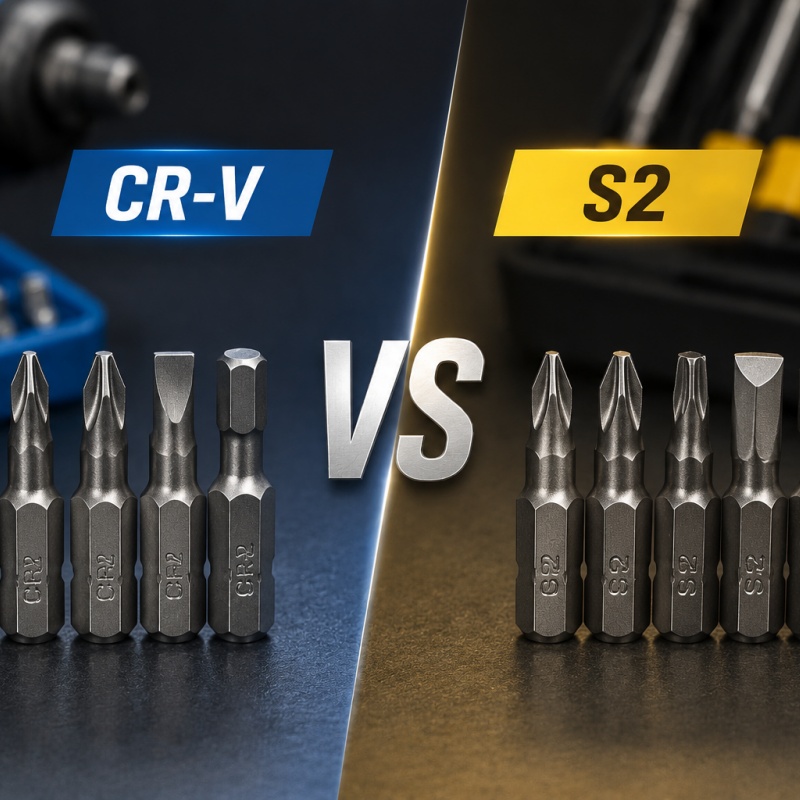
Cr-V and S2 are used for different tool-performance needs. Cr-V is widely used in durable hand-tool bodies such as sockets and wrenches, while S2 is commonly chosen for driver bits that need high hardness and resistance to repeated impact. The correct choice depends on the component, application, heat treatment, geometry, and test result.
Both materials can be suitable for quality tools. However, a screwdriver bit and a socket do not face the same stress. A bit must maintain tip geometry under repeated engagement; a socket body must resist torque and wear while fitting fasteners accurately. Material selection should therefore be made by component and application.
| Factor | Cr-V steel | S2 steel |
|---|---|---|
| Typical application | Wrenches, sockets, pliers, tool bodies | Screwdriver bits, impact-oriented bit applications |
| Key buying focus | Toughness, torque performance, corrosion protection | Tip wear, hardness balance, impact resistance |
| What to verify | Finished-tool strength, finish, fit | Bit geometry, hardness range, engagement test |
| Common mistake | Treating the grade name as full proof of quality | Choosing high hardness without checking brittleness |
Cr-V is often selected for hand-tool components that carry load across a larger body, including sockets, spanners, pliers, and ratchet components. Buyers should evaluate the finished part for fit, surface quality, torque performance, and resistance to normal storage corrosion.
Cr-V does not automatically mean all parts of a tool set must use the same steel. A mixed set can use different materials where their performance characteristics are more appropriate.
S2 is frequently specified for screwdriver bits because bit tips experience concentrated force and repeated contact with fastener recesses. For bits, verify tip accuracy, coating or finish if applicable, compatibility with target fastener types, and resistance to wear or deformation during a defined test.
An overly hard bit can become brittle; an insufficiently hard bit can wear quickly. The practical goal is a controlled balance, confirmed by testing rather than marketing wording.
Is S2 always better than Cr-V?
No. S2 is commonly a strong choice for bits, while Cr-V is widely suitable for many hand-tool bodies. “Better” depends on the component and the intended duty.
Can Cr-V be used for screwdriver bits?
It can be used in certain designs, but buyers should select and test the bit based on the expected application rather than choosing by material label alone.
What is the most important test for a screwdriver bit?
Use a repeatable engagement and turning test with the intended fastener profile and tool type. Inspect the tip for wear, rounding, cracking, or poor fit.
How should wholesalers specify a bit set?
Specify profiles, lengths, material requirement, target application, set configuration, case, markings, packaging, and acceptance criteria.

Copyright © Sinotools Industrial All Rights Reserved.. Technical Support:

 Live Help