+86 311 8533 5186
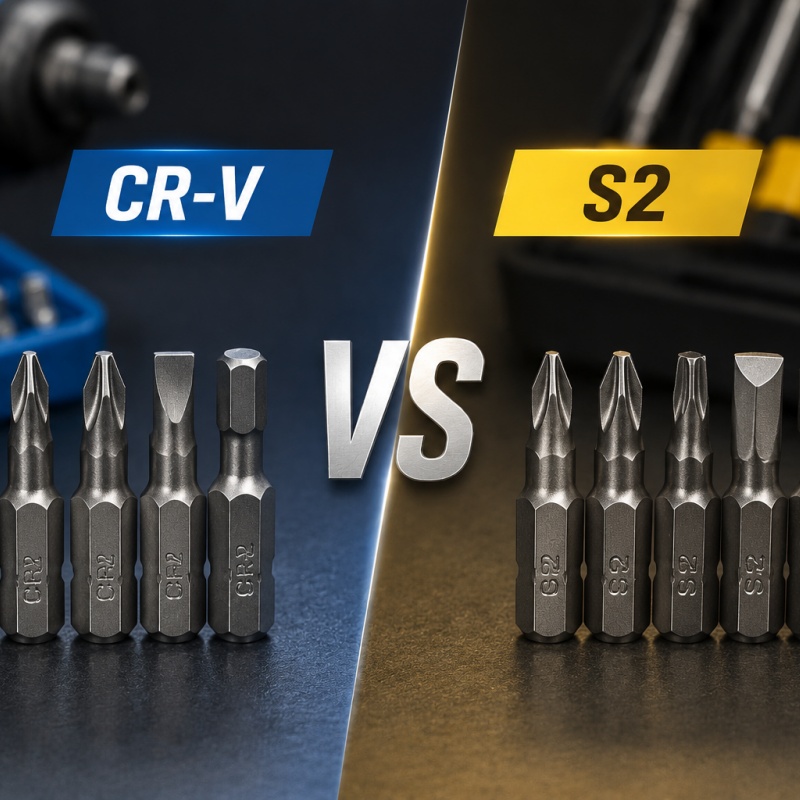
Cr-V and S2 are used for different tool-performance needs. Cr-V is widely used in durable hand-toolbodies such as sockets and wrenches, while S2 is commonly chosen for driver bits that need high hardness and resistance to repeated impact. The correct choice depends on the component, application, heat treatment, geometry, and test result.
CR-V, short for Chrome Vanadium steel, is an alloy steel that combines chromium and vanadium elements to improve strength, toughness, and wear resistance.
Chrome improves corrosion resistance and hardness, while vanadium enhances the steel’s toughness and structural stability. Due to its balanced performance and cost efficiency, CR-V steel is widely used in hand tools, sockets, wrenches, screwdrivers, and general-purpose tool accessories.
1. Good Balance Between Strength and Cost
CR-V steel provides reliable mechanical performance at a competitive price point. It is commonly selected for professional tools that require durability without significantly increasing manufacturing costs.
2. Excellent Wear Resistance
The addition of chromium improves surface hardness, helping CR-V tool bits maintain their shape during repeated use.
3. Suitable for General Applications
CR-V tool bits perform well in:
Household maintenance
Assembly operations
Automotive repair
General industrial applications
For standard fastening tasks, CR-V offers a practical combination of performance and affordability.
S2 steel is a silicon-chromium alloy tool steel specifically developed for applications requiring high impact resistance and toughness.
Compared with traditional alloy steels, S2 steel has a higher ability to absorb shock loads, making it widely used in screwdriver bits, impact driver bits, and professional fastening accessories.
1. Higher Torque Resistance
One of the biggest advantages of S2 steel is its excellent toughness. It can withstand sudden torque changes and impact forces without easily cracking or breaking.
This makes S2 steel particularly suitable for:
Impact drivers
Cordless power tools
Heavy-duty fastening applications
2. Better Impact Performance
During high-speed power tool operation, tool bits experience repeated impact stress. S2 steel’s structure allows it to flex slightly under pressure, reducing the risk of sudden failure.
3. Longer Service Life Under Heavy Loads
For professional users who frequently work with hard materials or high-torque tools, S2 steel bits usually provide longer working life compared with standard CR-V bits.
The main differences between CR-V and S2 steel tool bits can be compared through several important performance factors.
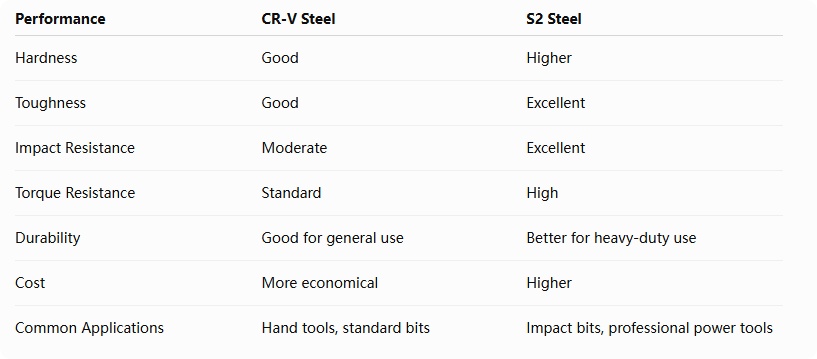
Cr-V is often selected for hand-tool components that carry load across a larger body, including sockets, spanners, pliers, and ratchet components. Buyers should evaluate the finished part for fit, surface quality, torque performance, and resistance to normal storage corrosion.
Cr-V does not automatically mean all parts of a tool set must use the same steel. A mixed set can use different materials where their performance characteristics are more appropriate.
S2 is frequently specified for screwdriver bits because bit tips experience concentrated force and repeated contact with fastener recesses. For bits, verify tip accuracy, coating or finish if applicable, compatibility with target fastener types, and resistance to wear or deformation during a defined test.
An overly hard bit can become brittle; an insufficiently hard bit can wear quickly. The practical goal is a controlled balance, confirmed by testing.
Both CR-V and S2 steel have advantages depending on the intended application.
CR-V steel offers a reliable and economical solution for general-purpose tools, while S2 steel provides superior performance for professional and heavy-duty fastening applications.
If you are looking for reliable tool bit solutions with customized material options, specifications, and OEM support, contact our team to discuss the best solution for your product line.

Copyright © Sinotools Industrial All Rights Reserved.. Technical Support:

 Live Help